Marton
Isabella Loudon
Two Years, One Building
214 Broadway, 8-10 December
Photos: Michael McKeagg
Art New Zealand, Autumn 2024
‘Isabella Loudon: Two Years, One Building’
by Frank Stark
Marton can sometimes seem a little sidelined a feeling emphasised by signs on both State Highways 1 and 3 urging drivers to make the detour. Those who do take the turn-off find a prosperous-seeming country town with a sturdy stock of Victorian and Edwardian shopfronts. Like lots of places throughout the country, however, Marton is facing a glum future. A combination of retail decline, earthquake risk and the pile-on of building code requirements has put most of its main street on notice.
On the edge of town, the fate of one set of buildings is already decided. A bookshop and a Chinese takeaway are due for demolition early in 2024. This is where Wellington artist Isabella Loudon has been working since 2022- as she pulls back temporarily from the pressures of a rapidly ascending career and a Covid-plagued city. The results are an expansion of both her studio and her work on display in Two Years, One Building, billed as a 'studio show' supported by Whanganui's Sarjeant Gallery.
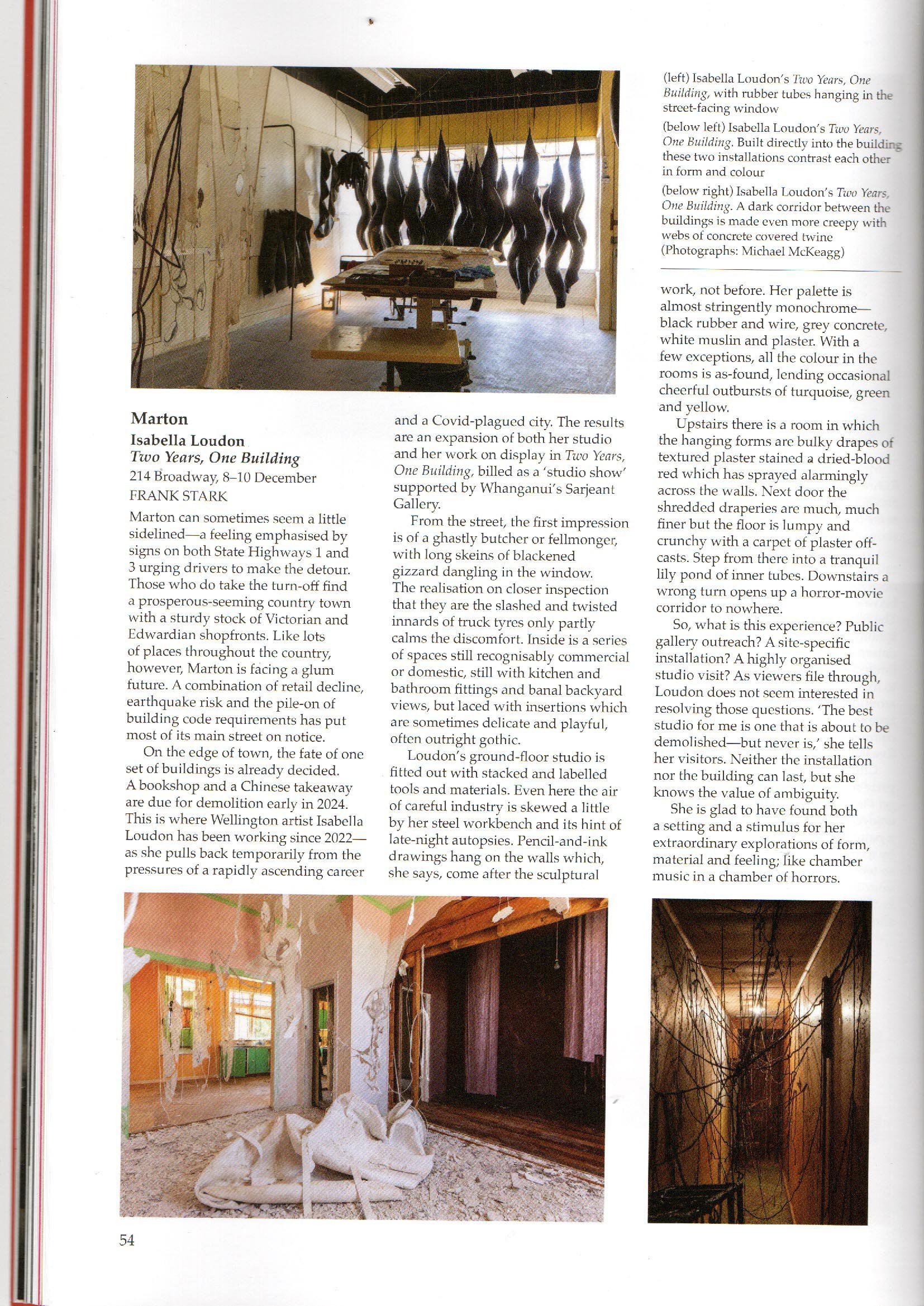
From the street, the first impression is of a ghastly butcher or fellmonger, with long skeins of blackened gizzard dangling in the window. The realisation on closer inspection that they are the slashed and twisted innards of truck tyres only partly calms the discomfort. Inside is a series of spaces still recognisably commercial or domestic, still with kitchen and bathroom fittings and banal backyard views, but laced with insertions which are sometimes delicate and playful, often outright gothic.
Loudon's ground-floor studio is fitted out with stacked and labelled tools and materials. Even here the air of careful industry is skewed a little by her steel workbench and its hint of late-night autopsies. Pencil-and-ink drawings hang on the walls which, she says, come after the sculptural work, not before. Her palette is almost stringently monochrome – black rubber and wire, grey concrete, white muslin and plaster. With a few exceptions, all the colour in the rooms is as-found, lending occasional cheerful outbursts of turquoise, green and yellow.
Upstairs there is a room in which the hanging forms are bulky drapes of textured plaster stained a dried-blood red which has sprayed alarmingly across the walls. Next door the shredded draperies are much, much finer but the floor is lumpy and crunchy with a carpet of plaster off-casts. Step from there into a tranquil lily pond of inner tubes. Downstairs a wrong turn opens up a horror-movie corridor to nowhere.
So, what is this experience? Public gallery outreach? A site-specific installation? A highly organised studio visit? As viewers file through, Loudon does not seem interested in resolving those questions. ‘The best studio for me is one that is about to be demolished – but never is,’ she tells her visitors. Neither the installation nor the building can last, but she knows the value of ambiguity.
She is glad to have found both a setting and a stimulus for her extraordinary explorations of form, material and feeling; like chamber music in a chamber of horrors.